
Dead Zones and Flickering Fixtures in Your Business? What a Complete Commercial Lighting Plan Actually Fixes
August 10, 2026
Quick Answer: A commercial space that has dark corners, flickering or humming fixtures, exterior lights that leave the parking lot half-lit, and emergency lights nobody's tested in years usually doesn't have one lighting problem, it has a lighting plan that was never built as one system. Interior lighting, exterior lighting, and emergency lighting each do a different job, general visibility, task work, security, safe egress, and when they're installed piecemeal over the years instead of designed together, gaps show up exactly where you need coverage most. Fixing it means looking at the building as a whole, not swapping one bad fixture at a time.
Walk your building after closing and turn off the lights you know are working fine. What's left is usually more revealing than what's lit. A stretch of hallway that's noticeably dimmer than the rest. A fixture over the loading door that's been humming for months. A parking lot corner that goes properly dark once the sun's down, the kind of dark where you can't make out a face or a license plate. An exit sign you assume still lights up but haven't actually checked since it was installed.
None of those are separate, unrelated annoyances. They're symptoms of the same root issue, a building that's accumulated lighting fixture by fixture, repair by repair, instead of being lit as a coordinated system. Fixing the humming ballast in the hallway doesn't touch the dark parking lot corner, and neither one tells you whether the emergency lights would actually come on if the power dropped tonight. Getting ahead of it means understanding what each layer of lighting is actually supposed to do.
Interior Lighting Is More Than "Bright Enough"
Most aging commercial spaces were lit for one job: general brightness. A grid of fluorescent troffers or a handful of high-bay fixtures spaced evenly across the ceiling, enough lumens to see by, and not much more thought put into it than that. That approach explains a lot of the complaints that show up over time, glare on computer screens, shadows over workbenches and counters, a break room that feels flat and uninviting compared to the sales floor.
A space that actually works uses three distinct layers instead of one flood of light. Ambient lighting is the base layer, even, general illumination spread across the whole room so nobody's walking through shadow. Task lighting sits on top of that, brighter and more directed light aimed exactly where detailed work happens, a workbench, a checkout counter, a prep station, so people aren't straining to see what they're doing. Accent lighting is the layer most commercial buildings skip entirely, lighting used to draw the eye toward a feature, a product display, an entrance, a reception area, which is often the difference between a space that reads as functional and one that reads as intentional.
When only the ambient layer exists, everything looks the same everywhere, evenly mediocre instead of well lit where it counts. Adding task lighting over workstations and thoughtful accent lighting at entrances and displays usually does more for how a space feels and functions than simply adding more ambient fixtures ever will.
Exterior Lighting That Actually Deters Trouble and Guides People Safely
Outside the building is where gaps get dangerous instead of just inconvenient. A parking lot with uneven coverage, bright near the entrance and pitch black along the back fence line, doesn't read as secure to an employee walking to their car at close. It reads as exactly the opposite, and it gives anyone with bad intentions a place to stand where nobody can see them.
Good exterior lighting isn't just "more lights." It's the right fixture doing the right job in the right spot. Entrances and walkways generally call for lighting on a photocell, so it comes on automatically at dusk and shuts off at dawn without anyone remembering to flip a switch. Parking areas and perimeter fencing benefit from motion-activated fixtures layered with a lower, constant baseline of light, full brightness kicks in the moment something moves, while a dimmer baseline keeps the area from ever going completely dark between triggers. Equipment yards and loading areas usually need broader flood coverage aimed to eliminate the deep shadows where a camera can't get a usable image.
Color temperature matters more than most business owners expect. A cooler white light, similar to daylight, tends to render faces, license plates, and colors more clearly than a warm yellow tone, which is part of why it's the standard choice for security-focused exterior fixtures. And glare works against you: a fixture that's too bright, aimed wrong, can actually make it harder to see past the pool of light it creates, not easier.
Tip:
Walk the exterior of your property at night, not during the day, and note where you instinctively slow down or feel less sure of your footing. Those spots, not the areas that already look bright, are where a lighting plan needs the most attention. Bring a phone camera and snap a photo of any area where you can't make out detail; it's a useful reference when describing the problem to whoever's designing the fix.
Emergency Lighting: The System You Hope You Never Need
Emergency and exit lighting is the layer that gets the least attention precisely because it's supposed to sit idle. Battery-backed fixtures over exits and along paths of travel are wired to switch over automatically the instant normal power drops, drawing off an internal battery so people can still see their way out during an outage, a storm, or anything else that takes the building dark. The problem is that a fixture can look perfectly normal on the wall for years while its battery has quietly failed, and the only way to know is to actually test it.
A simple habit catches most of that before it matters: hit the built-in test button on each unit roughly once a month and watch that the lamp head comes on and holds, and once a year, let the system run on battery power for a longer stretch to confirm it can actually carry the full duration it's rated for. That short monthly check is the difference between finding a dead battery on a Tuesday afternoon with the lights still on, and finding it the moment they're needed during an actual outage.
Eastern Oregon and the Tri-Cities see their share of winter storms and grid interruptions that can drop power to a commercial building with zero warning, which is exactly the scenario emergency lighting is built for. A battery backup system that's never been tested is a system nobody actually knows works, and that's a gap worth closing before it's discovered the hard way.
Why "Just Replace the Bulb" Doesn't Fix an Aging Lighting System
A fixture that flickers, hums, or takes longer to warm up than it used to isn't usually asking for a new bulb, it's telling you the fixture itself, or the wiring feeding it, is nearing the end of its useful life. Older fluorescent and HID fixtures rely on ballasts, components that regulate the electricity feeding the lamp, and ballasts degrade with age the same way any electrical component does. A flickering or humming fixture is frequently a failing ballast rather than a burnt-out tube, and swapping the tube alone just delays the same call for a few more weeks.
LED fixtures sidestep the ballast problem almost entirely and run cooler and longer than the fluorescent and HID technology they've largely replaced in commercial buildings, using a fraction of the energy of older incandescent and fluorescent lighting to produce the same output. That efficiency matters for day-to-day operating load, but the bigger practical win for most business owners is reliability: fewer fixtures failing on their own schedule, fewer half-lit rooms waiting on a maintenance call.
Warning:
Don't ignore a fixture that's warm to the touch at the base, discolored around the socket, or an exit sign that's dim, flickering, or dark. Those are signs of a wiring or connection problem behind the fixture, not just an aging bulb, and a dark or malfunctioning exit sign specifically means the one piece of lighting your building is counting on during an emergency may not work when it's needed. Get anything showing those signs looked at rather than waiting for it to fail completely.
What a Coordinated Lighting Plan Actually Considers
Fixing lighting one complaint at a time is how a building ends up with three different fixture types in one hallway and a parking lot that's bright near the door and dark everywhere else. A coordinated plan starts by walking the whole property, inside and out, and mapping where each layer, ambient, task, accent, security, and emergency, needs to do its job, then designing fixtures, controls, and placement around that map instead of around whatever's failing this month.
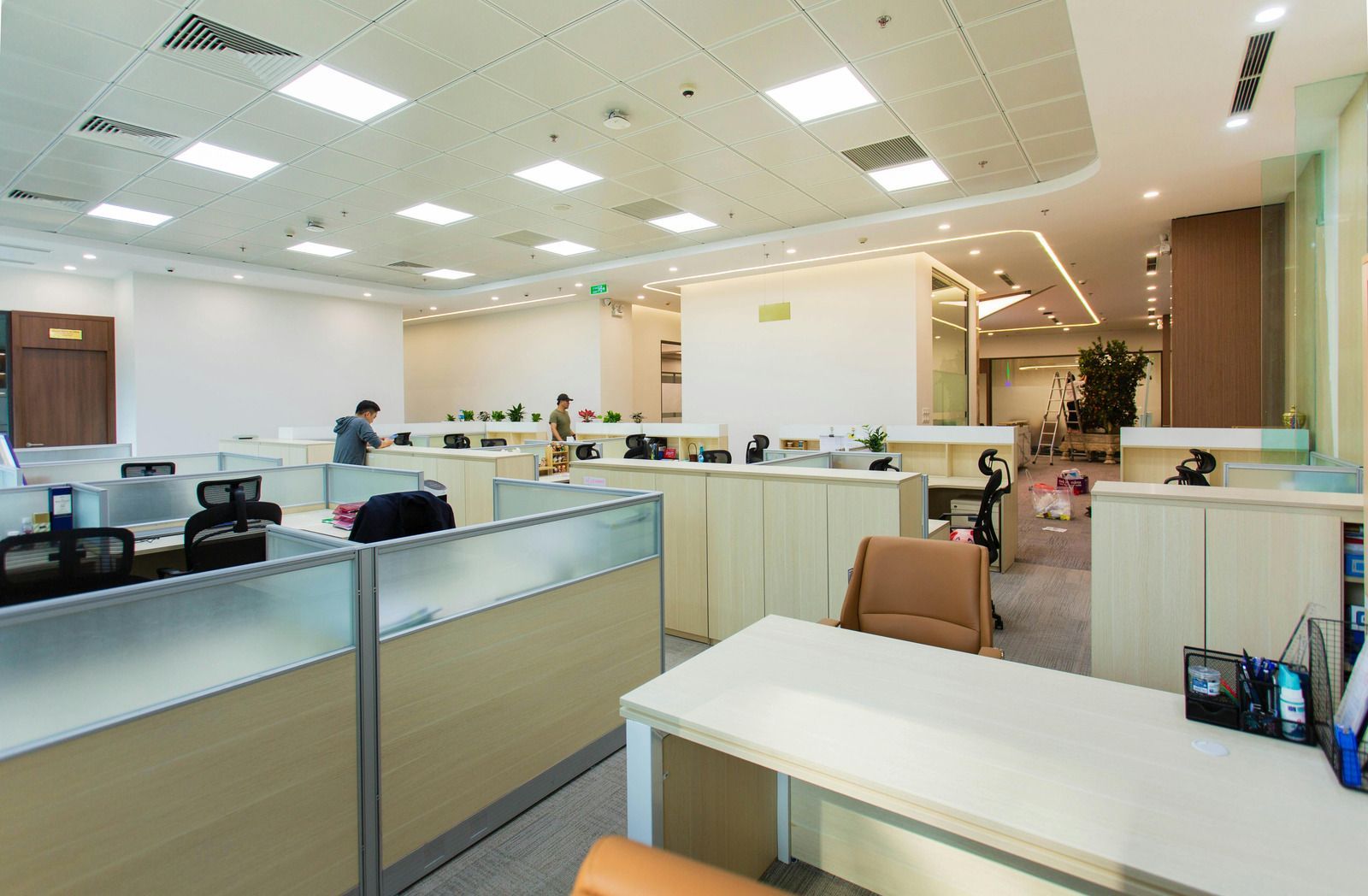
That looks different depending on the building. A warehouse or ag processing facility around Hermiston typically needs high-bay fixtures rated for dust and temperature swings, layered with brighter task lighting over inspection or packing stations, and exterior flood coverage sized for a yard full of trucks and equipment rather than a small parking lot. An office or retail space is closer to the opposite: softer ambient light, accent lighting that draws attention to a display or entrance, and exterior lighting scaled to guide customers and employees safely to their cars rather than illuminate acres of yard. Neither approach is right for the other building, which is exactly why a lighting plan built around the specific space tends to outperform one built around whatever fixtures happened to be on sale when something last burned out.
Frequently Asked Questions
How do I know if my building needs a full lighting plan instead of just fixing what's broken?
If different fixtures keep causing problems, individual repairs may not be enough. A full lighting plan addresses brightness, coverage, consistency, efficiency, and how all fixtures work together throughout your building.
Can I mix LED fixtures with the older fluorescent or HID fixtures I already have?
Yes, temporarily. However, mixing LED, fluorescent, and HID fixtures can create uneven brightness and color temperatures. Converting an entire area together usually provides more consistent illumination, appearance, efficiency, and performance.
What's the actual difference between motion-activated and dusk-to-dawn exterior lighting?
Dusk-to-dawn lights provide continuous nighttime illumination, while motion-activated fixtures brighten when movement is detected. Many properties combine both options to maintain visibility while improving energy efficiency around entrances and walkways.
How often should emergency lighting actually be tested?
Emergency lighting should receive quick functional testing about monthly, with longer battery-duration testing approximately once yearly. Regular testing confirms lamps, batteries, and backup systems will operate properly during unexpected power outages.
My exterior lights seem bright enough during a walk-through in daylight. Why would that not be enough?
Daylight cannot reveal nighttime lighting problems such as glare, shadows, poor color rendering, or dark zones. An after-dark evaluation shows how effectively exterior fixtures illuminate entrances, walkways, parking areas, and surroundings.
Does a custom lighting design cost more than just replacing fixtures as they fail?
Custom lighting requires upfront planning, but repeated fixture replacements can create ongoing service costs. A coordinated design addresses coverage, efficiency, appearance, and functionality together, reducing the need for recurring individual repairs.
A Complete Lighting Plan Closes Every Gap
Dead zones, flickering fixtures, uneven exterior coverage, and unreliable emergency lights often point to a system that has been repaired in pieces rather than planned as a whole. A complete commercial lighting plan brings interior, exterior, security, task, and emergency lighting together so each area receives the right level of illumination. For businesses in Hermiston, Oregon, Rock Electric brings 35 years of experience to creating coordinated lighting systems that support visibility, consistency, safety, reliability, and everyday building use.
When every layer of lighting is considered together, the building becomes easier to navigate, maintain, and manage after dark or during unexpected outages. Work areas receive focused illumination, entrances and parking areas stay consistently visible, and emergency fixtures remain ready when normal power disappears. Instead of repeatedly addressing whichever fixture fails next, a coordinated approach corrects the underlying gaps across the property. The result is a more balanced lighting system designed around how the commercial space actually operates each day.