
Lights Flickering When the Well Pump or AC Kicks On? What Your Wiring Says
September 28, 2026
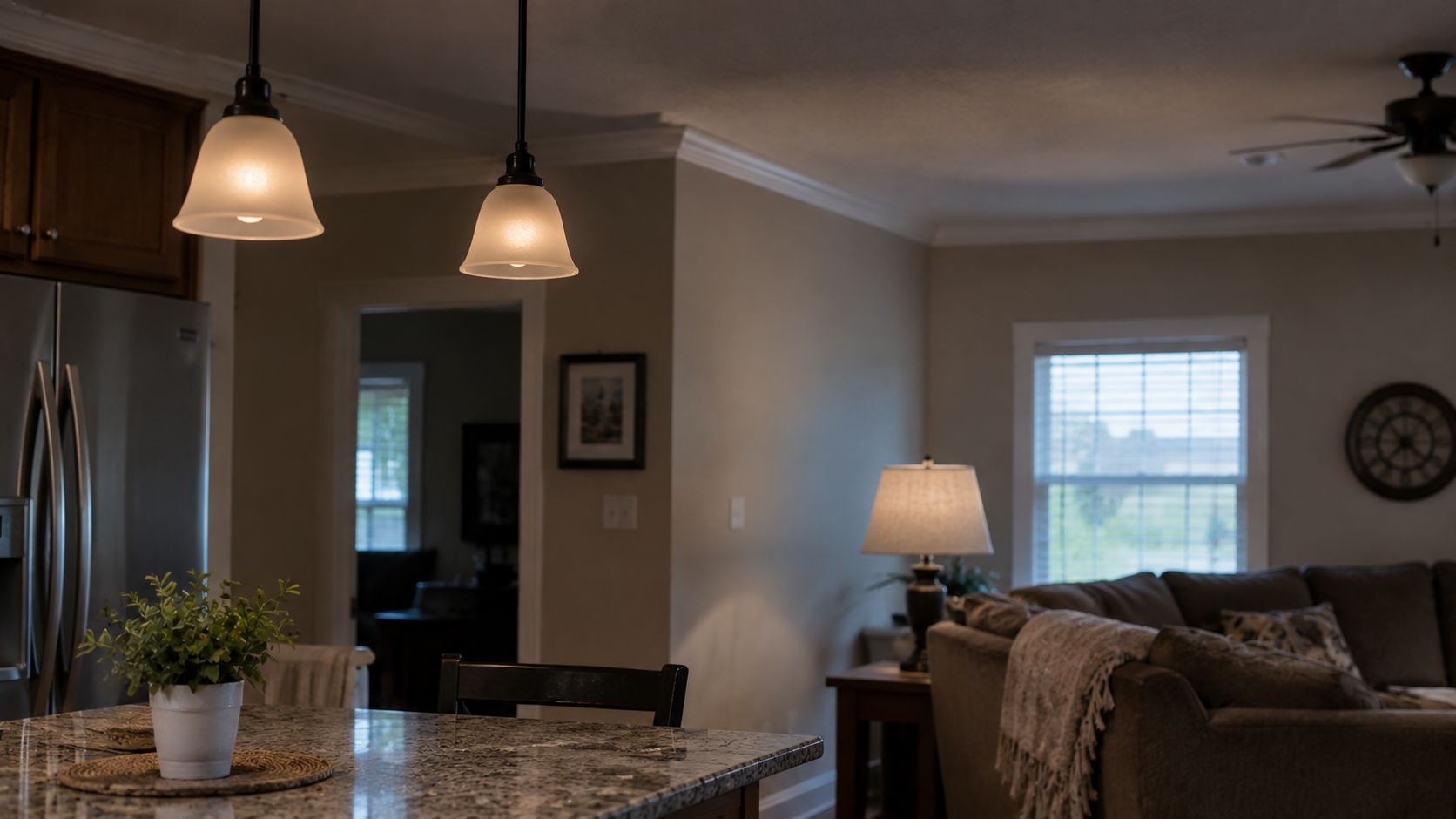
Quick Answer: A quick dip in your lights the instant a well pump or AC compressor kicks on is usually just the motor drawing a brief surge of starting current. That surge can run five to eight times the motor's normal running amperage, and it pulls system voltage down for a fraction of a second. That's normal on most homes. It stops being normal when the dip is deep, when it lingers, or when it shows up on circuits nowhere near the pump or AC. The same goes for warm outlets, a burning smell, or a breaker that's started tripping. Those point to a wiring or connection problem, not the motor.
You're in the kitchen when the well pump kicks on in the crawlspace, and for half a second every light in the room sags before snapping back. Or the AC compressor cycles on outside, and the lamp on the end table dims right along with it. Out around Hermiston and the Tri-Cities, plenty of homes run their own well alongside a full-size AC or heat pump. That little dip is one of the more common questions a homeowner ends up asking. Most of the time it's curiosity, not a real problem. But not always, and the difference is worth five minutes of your attention before you either shrug off something that needed a look, or call someone about a motor doing exactly what motors do.
Why a Motor Starting Pulls the Lights Down for a Second
Every motor needs more current to get its rotor spinning from a dead stop than it needs once it's up to speed. A submersible well pump, an AC compressor, a well pump's own control box relay, all of them. That initial surge has a name, locked rotor amps, and it commonly runs five to eight times the motor's normal running current. A pump or compressor rated at 15 running amps might briefly pull well over 100 amps in that first fraction of a second. Then it settles back down, usually inside a half second to a few seconds.
That surge doesn't stay put on the pump's own circuit. It travels back through the branch wiring, through the panel, and out along the service conductors feeding your home. Current flowing through a wire's resistance drops voltage as it goes. For that brief instant, the whole system sags a little, and every light connected to it sags right along with it. Incandescent and older halogen bulbs show this the most, since their brightness tracks voltage almost instantly. A drop of just a volt or two on a 120-volt circuit is enough for a homeowner used to their own lights to catch it out of the corner of their eye. LED bulbs stay steadier through the same dip, which is one reason two houses with the identical pump can look like they have two completely different problems.
When It's Normal and When It Should Get a Second Look
A flicker that's brief, mild, and tied to the exact moment the pump or compressor cycles on is doing exactly what a properly sized system does. Lights dip, the motor spins up, voltage recovers, everything's steady again within a second or two. Same pattern, every single time. That's the signature of normal starting current and nothing more.
Severity and spread are what change the picture. A dip deep enough that lights nearly go dark, or one that drags on for several seconds instead of snapping back, is pulling more voltage than a well-sized circuit should ever give up. Flicker on circuits that have nothing to do with the pump or AC points somewhere else entirely, usually a shared connection point at the panel or the main neutral. And flicker that's crept up worse over the past few months, with no new appliance or motor added anywhere in the house, usually means one thing. A connection has loosened somewhere, rather than the motor suddenly asking for more power than it used to.
Tip:
Time it. A dip that starts the instant the pump or AC audibly kicks on and clears within a couple of seconds is normal starting current, plain and simple. A flicker with no clear tie to an appliance cycling is a different pattern. So is one that keeps happening well after a motor should already be up to speed. Either way, mention exactly what you noticed to whoever looks at it.
Wiring and Panel Issues That Turn Normal Flicker Into a Real Problem
A well-sized circuit absorbs a motor's starting surge without much drama. A few things routinely turn that mild, expected dip into something bigger. Undersized wire is the most common culprit, especially on well pumps, which often run a long conductor from the panel out to the pressure tank and wellhead. The National Electrical Code's guidance calls for keeping branch circuit voltage drop around 3%, with the combined feeder and branch circuit staying near 5% total. A conductor that's too small for the distance and the motor's amperage blows past both numbers under a starting surge. That's true even if it handles the running load fine every other minute of the day.
Loose connections cause the same trouble, and they're often more serious than they sound. A neutral connection that's worked loose at the panel, the meter base, or the service entrance can cause flicker that shows up unevenly across circuits. Sometimes it follows no pattern that matches the pump or AC at all. It can develop without ever tripping a breaker. That's exactly why it tends to go unnoticed until it's already gotten worse.
Aging breakers and worn panel bus connections add to the same problem, since a connection degraded by years of heat and current has more resistance than it did the day it was installed. More resistance means more voltage lost right when the motor needs it most. Farms and rural properties around eastern Oregon and the Tri-Cities add a shop, an irrigation pump, or a second well over the years more often than not. The panel ends up carrying more starting loads than it was ever set up to handle smoothly.
Warning:
A breaker that's started tripping when the pump or AC kicks on is not part of a normal starting-current dip. Neither is an outlet or panel that's warm to the touch, or a burning odor near the panel. Those point to a connection under real strain, and running the system while ignoring them raises the odds of a much bigger failure down the line. Shut off the affected circuit if you can do it safely, and get it looked at rather than waiting to see if it clears up on its own.
What an Electrician Actually Checks
Diagnosing flicker starts with confirming what's actually happening instead of guessing from how bright a bulb looks. That usually means measuring voltage at an outlet or the panel while the pump or AC cycles on, to see the real size of the dip. From there, the wire feeding the motor gets checked against its length and amperage, to confirm it's sized to keep voltage drop where the load needs it. A run that was fine for a smaller pump years back doesn't automatically work for whatever replaced it.
Connections get checked next. The neutral and hot lugs at the panel, the main breaker, and the meter base connection all get a look for looseness or corrosion. These are exactly the spots where resistance quietly builds over years of heating and cooling. On a well pump specifically, the control box and pressure switch contacts get checked too. A pitted or worn contact there can make the starting surge worse than the motor itself would ever cause on its own.
For a system that's marginal but not truly undersized, a soft-start device on the pump or compressor sometimes solves it. It ramps the motor up over a second or two instead of demanding full locked rotor current all at once. That eases the voltage sag the rest of the house feels every time that motor starts.
Frequently Asked Questions
Is it normal for lights to flicker every single time the AC or well pump turns on?
Yes, as long as the dip stays brief and clears within a second or two. Predictable flicker tied to the exact moment a motor starts is the normal signature of starting current, not a fault.
Why do my LED bulbs seem unaffected while my older lamps flicker noticeably?
LED bulbs respond to voltage dips less visibly than incandescent or halogen bulbs, whose brightness tracks voltage instantly. A mix of bulb types looks like inconsistent wiring when it's really just different bulbs reacting differently.
Could my well pump's control box be causing worse flicker than the pump motor itself?
Yes. Pitted or worn contacts inside the control box or pressure switch add resistance right where the starting surge happens, making the dip more pronounced than a healthy control box would with that same pump.
Does a bigger AC unit or a newer, more efficient pump motor mean worse flicker?
Not by size alone. A motor swap can change starting characteristics enough to make flicker more noticeable even when the running load is similar or lower than before, explaining why it sometimes follows a replacement.
If only one room flickers and the rest of the house doesn't, does that rule out a panel problem?
Not on its own. It often points toward that circuit's own wiring or a shared connection closer to that part of the house. A panel issue can still show unevenly, so the pattern deserves checking.
Can a whole-house surge protector or voltage regulator fix flicker from motor starting?
No. Those devices guard against transient spikes and swells, not the momentary sag from a motor's own starting current. The fix for starting-current flicker sits almost always in the wiring, connections, or the motor's behavior.
How can I tell the difference between normal flicker and a loose neutral without an electrician?
It's hard to confirm from outside, since a loose neutral resembles ordinary flicker at first. Flicker spreading to unrelated circuits, brightness that swings rather than dips once, or timing that ignores the pump signal trouble.
Knowing When Flicker Is Worth a Closer Look
Most of the time, a brief dip when your well pump or AC starts is simply the motor pulling its starting surge, and there's nothing behind it worth worrying over. The pattern that reassures is a consistent one: a mild sag that clears within a second or two, timed to the exact moment the motor spins up. When the flicker behaves this way every time, it reflects a system doing precisely what a properly sized setup is built to handle.
The picture shifts when the dip deepens, lingers, spreads to unrelated rooms, or arrives with a warm
panel or a breaker
that has started tripping. Those signs trace back to wiring or a connection rather than the motor, and they tend to worsen quietly until something gives. Rock Electric
has spent 35
years in Hermiston, Oregon, following flicker back to its source, measuring the actual voltage drop rather than reading it off a dimming bulb, so the true cause surfaces.